JACK GE
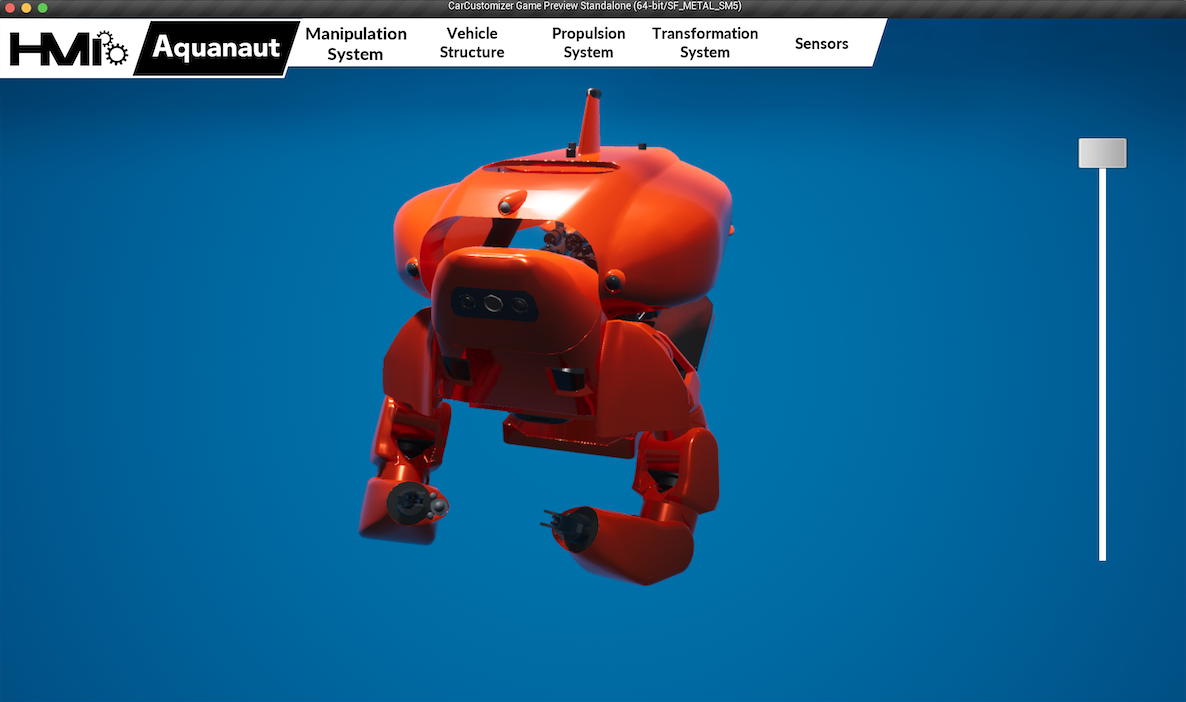
AquanautViz project hero

Product Design Leadership · 3D Visualization · VR · Houston Mechatronics, Inc. · 2018

AquanautViz

I led the design of a real-time 3D visualization system used to present and interact with Houston Mechatronics' subsea robotics platform.

The project focused on translating highly complex mechanical systems into an experience that could be understood immediately by non-technical stakeholders, while remaining accurate and performant enough for expert use. The product launched at the 2018 Offshore Technology Conference (OTC) and was adopted as a primary sales and demonstration tool.

Role
Lead Product Designer
Tools
Unreal Engine · C++ · Maya · Solidworks · Adobe CC · HTC Vive

The robots themselves were advanced, but the way they were presented was not.

Clients were asked to interpret dense specifications and static CAD models—an approach that required technical literacy and failed to convey system behavior, scale, or relationships. Existing CAD assets were also unsuitable for real-time interaction, making them impractical for tablets or immersive environments.

The core problem was clarity: how to reveal system complexity without overwhelming the user.

I designed the experience around progressive disclosure and spatial hierarchy.

Rather than exposing all components simultaneously, the system presents a clear system-level view, allowing users to explore subsystems only when context is established. Visual emphasis is managed through a holographic rendering model: inactive components remain as lightweight outlines, while selected systems transition into full-detail states.

This approach allowed users to maintain orientation while interacting with complex assemblies.

To support real-time performance, I rebuilt the entire 3D asset set from engineering exports, reducing polygon density by over 80% while preserving visual intent and proportional accuracy.

01

Asset Strategy

Engineering models were redesigned specifically for real-time interaction. Visual fidelity was prioritized only where it supported understanding, establishing a reusable asset standard for future visualization work.

02

Interaction Model

Navigation was structured hierarchically, anchoring users at the system level and revealing deeper layers contextually. The visual language established here became the foundation for subsequent internal visualization tools.

03

Platform Alignment

The experience was designed to scale across iOS tablets, Windows desktops, and HTC Vive, with consistent interaction principles adapted to each context rather than redesigned per platform.

What changed

01

Launch

Launched publicly at OTC 2018

02

Application

Used in client presentations and immersive demos

03

User Impact

Improved comprehension of system architecture for non-technical audiences

04

Legacy

Established internal standards for real-time 3D visualization and interaction design

Next projectAutomated Control