JACK GE
Unified Enterprise Data Platform project hero

Lead Product Designer · JLL · 2025

Unified Enterprise
Data Platform

I led the design of a unified web experience for a large enterprise data platform used across multiple business units.

The platform had grown organically over time and supported a wide range of capabilities—including data discovery, access management, quality, observability, governance, and analytics—but the user experience was fragmented across multiple tools and entry points.

As the sole designer, I was responsible for defining the experience strategy and designing a single, scalable product surface that supports the full lifecycle of platform usage—from evaluation and onboarding to day-to-day operations.

Role
Lead Product Designer (Sole Designer)
Tools
Figma · Design Systems · Information Architecture · Prototyping

As the enterprise data platform grew, its user experience became increasingly fragmented across disconnected tools and services.

Teams struggled to discover data, navigate workflows, and manage operations consistently. This increased onboarding friction, reduced visibility into data quality and reliability, and slowed platform adoption.

The challenge was to make a complex ecosystem feel like one coherent product.

I designed a unified experience layer that connected fragmented tools and workflows across the enterprise data lifecycle.

I organized the experience around the core data workflows—discovery, access and sharing, data quality, observability, and governance—so teams could move between capabilities through one consistent interface without rebuilding underlying systems.

01

Understanding User & Business Needs

Fragmented tools and high learning costs. Teams relied on too many disconnected tools and services, making it difficult to know where to go, which tool to use, or how to complete a task. This increased the learning curve and wasted time.

Broken workflows and limited transparency. Data access requests lacked clear ownership, status visibility, and actionable feedback. Users often did not know what would happen next or how to follow up.

High costs and underutilized services. Overlapping software and services increased operating costs, while existing capabilities remained underused, limiting the value of technology investments.

02

Designing the Platform Structure

Navigation & User Flows. Defined the information architecture, navigation, and key user flows early to support both current workflows and future platform expansion.

Scalable Design Templates. Established reusable page layouts, templates, and interaction patterns so features could be added, modified, or removed without redesigning the platform.

Product & Service Analysis. Reviewed existing third-party tools and internal services to identify shared functionality, usability issues, and opportunities to improve the unified experience.

Cross-Team Integration. Connected workflows across data teams, defining how features interact, how information moves between services, and how users receive status updates and feedback.

03

Designing & Building with Engineers

Engineering Collaboration. Worked directly with engineers during development sprints to refine UI details, resolve technical constraints, and ensure design consistency.

AI-Assisted Development. Used Claude Code to work directly in the production codebase, implementing UI changes and refining components instead of relying solely on design handoffs.

Production-Ready UI. Contributed code changes intended for production, collaborating with engineers on implementation and iteration.

04

MVP & Launch

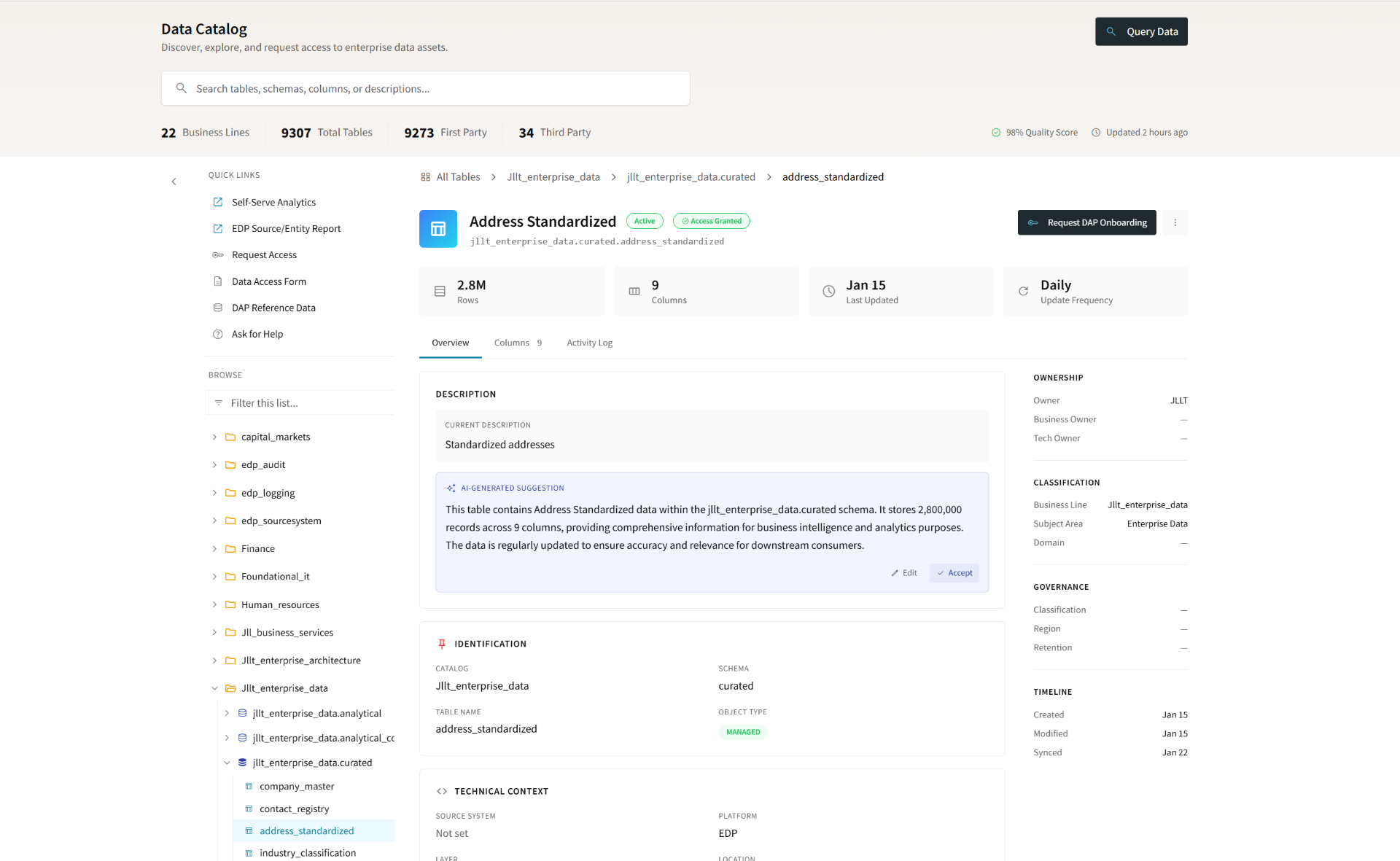
First Release. Launched four core modules: the platform homepage, Data Catalog, Data Quality, and Data Lineage.

Initial Adoption. The first release supported two main user groups:

Data Governance Team (~30 users). Used the platform to manage and monitor data quality, lineage, and governance workflows.

Engineers Across Teams (dozens initially). Used Data Catalog to discover datasets and understand their contents.

Additional project visuals

Enter the case-study password to view confidential project material.

Enter the case-study password to continue.

What changed

01

Platform Consolidation

Consolidated multiple third-party tools and services into one unified enterprise data platform.

02

Cost Savings

Hundreds of thousands USD saved annually

Reduced annual software and service costs through platform consolidation.

03

End-to-End Data Workflows

Connected workflows across teams and the end-to-end data lifecycle—from ingestion, processing, and storage to analytics, governance, access requests, and management—improving efficiency and transparency.

04

Operational Reliability

Reduced the risk of data errors by streamlining data-team workflows, clarifying ownership, and standardizing previously ambiguous processes.

05

Trust & Clarity

Built greater confidence in the data platform and the teams behind it through clearer workflows, more transparent status and ownership, and easier-to-use services—removing ambiguity around previously unclear processes.

06

Organizational Impact

Helped elevate the visibility and influence of the growing data organization as the platform continued to evolve, supporting a more structured, enterprise-wide approach to data science at JLL.

Next projectAI Application for Enterprise Data Exploration